Creating a Cinematic Experience at Home
A true home theater is more than a collection of equipment. It is a carefully designed environment where architecture, acoustics, and technology work together to create a cinematic experience within the comfort of home.
Luxury home theaters combine precise speaker placement, architectural planning, acoustic treatment, and advanced visual systems to recreate the depth and emotion of a professional cinema. When designed correctly, the room becomes an immersive space where sound surrounds the listener and the visual experience feels larger than life.
1. Architectural Foundations of a Home Theater
Every exceptional theater begins with thoughtful architectural planning. The room itself plays a crucial role in determining the overall performance of the audio system.
A rectangular room is generally preferred because it allows sound waves to travel more evenly compared with square rooms, which can produce uneven bass response.
Recommended design considerations
- Room width should ideally be 1.6 times the height
- Room length should be 2.3 times the height
- Ceiling height should ideally be 9–10 feet
These proportions help prevent acoustic issues such as standing waves and bass buildup.
Dark wall finishes, acoustic panels, and soft furnishings are commonly used in luxury theaters to reduce sound reflections and maintain visual focus on the screen.
2. The Screen and Viewing Geometry
The visual focal point of the room is the screen.
Most premium home theaters use large projection screens rather than televisions, as projection creates a more authentic cinematic scale.
Screen placement principles
- The screen should be centered on the front wall
- The bottom of the screen should be roughly 24–36 inches above the floor
- The viewing distance should be approximately 1.2 to 1.5 times the screen width
For example:
- A 120-inch screen typically suits seating at around 11–12 feet away.
Tiered seating platforms can be introduced in larger theaters to maintain clear sightlines for viewers seated in multiple rows.
3. Speaker Layout and Soundstage Design
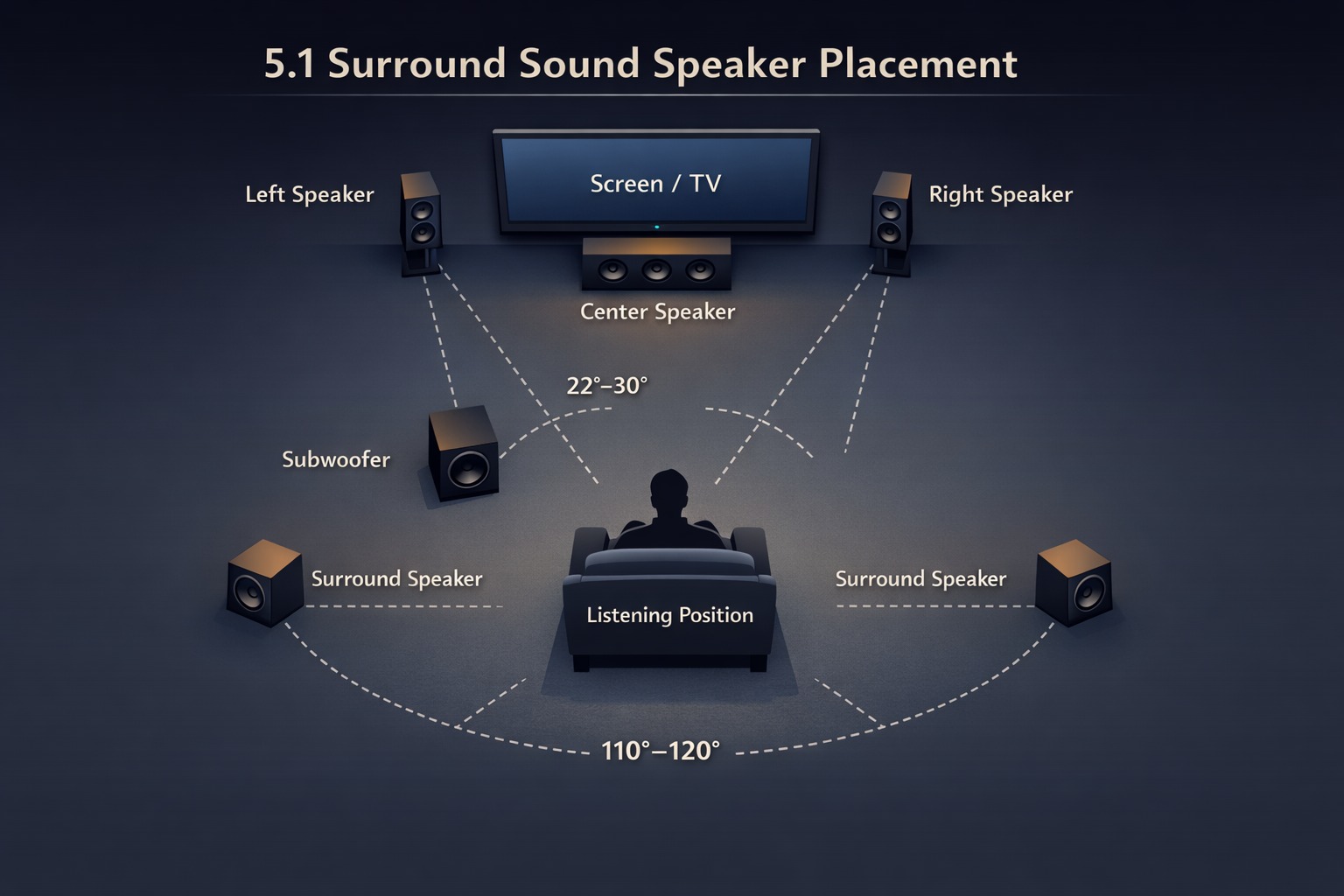
In a well-designed theater, the speaker system creates a three-dimensional sound field that surrounds the listener.
A typical luxury home theater uses 5.1, 7.1, or Dolby Atmos systems.
Front Speakers
The front soundstage consists of three speakers:
- Left speaker
- Center speaker
- Right speaker
These should form a symmetrical triangle with the main listening position.
The center speaker, responsible for dialogue clarity, should be placed directly below or behind the screen.
Front speakers should be positioned at ear height when seated.
Surround Speakers
Surround speakers create environmental effects and directional sound.
Placement guidelines:
- Located slightly behind the seating area
- Positioned 110–120 degrees relative to the listener
- Mounted 1–2 feet above ear level
In a 7.1 system, two additional rear speakers are placed behind the audience to extend the sound field further.
4. Subwoofer Integration
Subwoofers deliver the low-frequency energy that adds realism and impact to cinematic soundtracks.
Unlike other speakers, bass frequencies are less directional, meaning the subwoofer can be positioned in several locations.
Common placements include:
- Front corners of the room
- Along the front wall
- Mid-wall placement
In larger theaters, dual subwoofers are often used to distribute bass evenly throughout the room.
5. Projector and Visual System Design
A premium home theater usually relies on a high-quality projector and screen combination.
The projector should ideally be mounted on the ceiling behind the seating area and aligned with the center of the screen.
Typical projector throw distances
- 100-inch screen → about 10 feet
- 120-inch screen → about 12 feet
- 150-inch screen → about 16–17 feet
Short-throw and ultra-short-throw projectors can reduce the required distance.
Proper projector alignment ensures accurate image geometry and brightness across the screen.
6. Acoustic Treatment and Sound Control
Even the finest speakers cannot perform properly without acoustic treatment.
Luxury theaters typically include:
- Absorption panels on side walls
- Bass traps in room corners
- Diffusers on rear walls
- Acoustic ceiling treatments
These elements control reflections and maintain clarity, allowing dialogue and music to remain precise and intelligible.
7. Lighting and Atmosphere
Lighting contributes significantly to the theater experience.
Professional home theaters often use:
- Dimmed ambient lighting
- LED step lighting for safety
- Wall sconces for atmosphere
- Smart lighting systems with remote control
Blackout curtains or windowless rooms ensure optimal screen contrast.
8. Equipment Integration and System Control
A luxury theater typically includes:
- AV receiver or processor
- Power amplifiers
- Media players and streaming systems
- Smart automation control
Centralized equipment racks and concealed cabling keep the room visually clean while maintaining easy access for maintenance.
9. Calibration and Fine Tuning
Once the system is installed, professional calibration is essential.
Calibration includes:
- Speaker level balancing
- Time alignment
- Room correction processing
- Subwoofer integration
These adjustments ensure the entire system performs as a cohesive, balanced environment.
The Final Experience
A well-designed home theater does more than reproduce sound and images—it recreates the atmosphere of cinema.
When architecture, acoustics, speaker placement, and visual design are considered together, the result is an immersive environment where every film, concert, or game becomes a memorable experience.
For companies like NOISE, the goal of home theater design is simple: